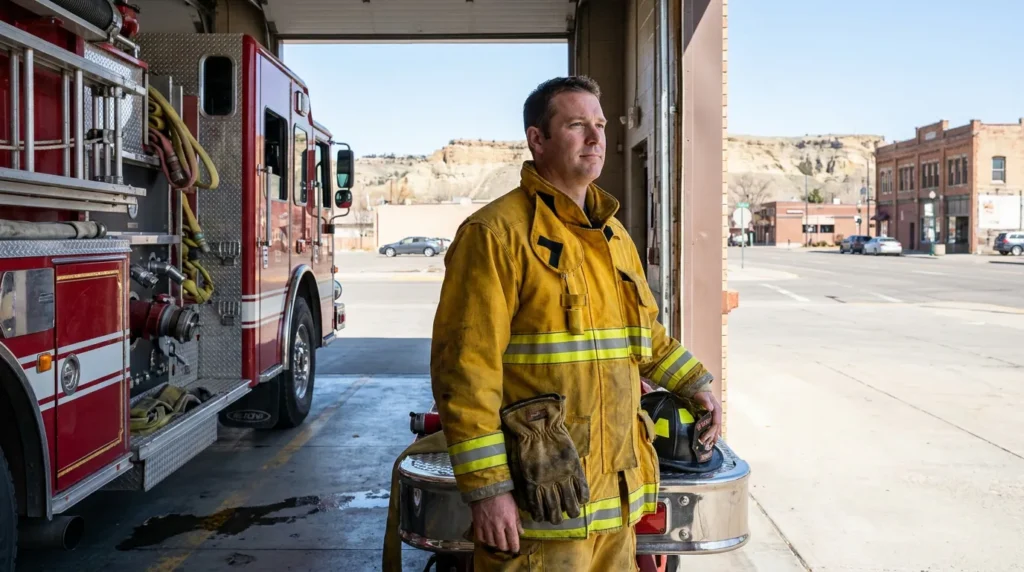

Montana Firefighters, Cancer, and the Law That Shifts the Burden
Key Takeaways: Montana’s firefighter presumptive occupational disease law (MCA 39-71-1401) presumes a covered firefighter diagnosed with a listed disease within the statutory timeframe has a compensable claim, shifting the burden of proving causation. The presumption is rebuttable by insurers based on tobacco use history, medical exam compliance, diagnosis timing, or eligibility. To qualify, a firefighter’s primary duties must involve extinguishing or investigating fires, with at least one year of Montana service beginning on or after July 1, 2019. Coverage is optional for volunteer departments where workers’ comp is voluntary. Benefits match workplace injuries under MCA 39-71-713(1), subject to the statewide aggregate cap for total benefits under MCA 39-71-1401(6). Disputes are resolved through Title 39, chapter 71, part 24 procedures and the Montana Workers’ Compensation Court.
If you have spent years in turnout gear in Billings, you know the job follows you home. Montana’s presumptive occupational disease law at MCA 39-71-1401 says that a covered firefighter who meets the requirements of MCA 39-71-1402 and is diagnosed with a listed disease within the statutory period is presumed to have a compensable claim. Instead of proving the fire ground caused your cancer or heart condition, the law may start from the assumption it did. This is a rebuttable presumption, not a guarantee, and the conditions in MCA 39-71-1402 must be satisfied before it applies.
Need a straight answer about your situation? The team at Miller Tourtlotte Law handles Montana workers’ comp claims daily. Call 406-888-2222 or reach out to our office to discuss your case.
Who Actually Counts as a “Firefighter” Under the Statute
Not everyone who has pulled a hose fits the statutory definition. Under MCA 39-71-1401(10)(a), a “firefighter” means an individual whose primary duties involve extinguishing or investigating fires, with at least one year of firefighting operations in Montana beginning on or after July 1, 2019, and who falls within the listed categories, including certain volunteer firefighters whose employers elected coverage. That start date matters. A career firefighter who retired in 2016 generally may not qualify.
The word “primary” does heavy lifting. Fire investigators are included, but someone with mostly administrative duties may face arguments they do not qualify. These are fact-driven questions, and courts may consider job descriptions, run logs, and testimony about actual duties. If your role was mixed, have the specifics reviewed before assuming you qualify.
Volunteer and Rural Departments: An Important Catch
Presumptive coverage is not automatic for every department. MCA 39-71-1401(1)(b) provides that coverage is optional for employers of firefighters whose workers’ comp coverage is voluntary. This directly affects volunteer firefighters, who comprise a large share of the fire service across Yellowstone County and rural Montana. Employers under MCA 7-33-4109 or 7-33-4510 may elect to obtain presumptive occupational disease coverage, subject to insurer agreement.
Here is the practical reality. If your volunteer department never elected that coverage, the presumption may not be available, regardless of how many structure fires you worked. You may still pursue a traditional occupational disease claim under Title 39, chapter 71 if otherwise covered, but you would carry the burden of proving causation. Check your department’s election status early.
\u{1F4A1} Pro Tip: Ask your fire chief or business office, in writing, whether presumptive occupational disease coverage was elected and with which insurer.
How the Montana Firefighter Presumptive Occupational Disease 39-71-1401 Framework Fits the Bigger Picture
This statute is stitched into Montana’s whole workers’ comp system. MCA 39-71-1401(8) provides that “occupational disease” includes a presumptive occupational disease when used in four specific definitions within MCA 39-71-116 (‘claims examiner’, ‘permanent partial disability’, ‘primary medical services’, and ‘treating physician’) and when used in a specific enumerated list of other sections within Title 39, chapter 71, thereby integrating firefighter presumptive disease claims into designated parts of the broader workers’ compensation system.
The baseline comes from MCA 39-71-713(1), which provides that compensation for occupational diseases equals the compensation and medical benefits provided for injuries under the chapter. A firefighter with a covered presumptive disease receives the same categories of wage-loss and medical benefits as a worker hurt in a fall, subject to the statute’s $5 million aggregate cap for all claims. You can read the full statutory language on occupational disease compensation.
There is an anti-duplication rule. Under MCA 39-71-713(2), when a condition could be claimed both as an injury and occupational disease, compensation may not be duplicated for the same conditions over the same time period.
The law is deliberately narrow. MCA 39-71-1401(9) states the provisions apply only to presumptive occupational diseases for firefighters, not to other workers’ comp issues, and may not be used as guidance in administering Title 33 or 37. This presumption is a firefighter tool, and health insurers or licensing boards are generally not bound by it.
|
Issue |
What the statute provides |
Where it comes from |
|---|---|---|
|
Presumption of compensability |
Presumed claim if requirements met and listed disease (e.g., primary site cancers such as brain, bladder, kidney, colorectal, prostate, leukemia, non-Hodgkin’s lymphoma, and certain heart and lung conditions) diagnosed in set period |
MCA 39-71-1401(1)(a) |
|
Who qualifies |
Primary duties extinguishing or investigating fires; 1+ year in Montana on or after 7/1/2019 |
MCA 39-71-1401(10)(a) |
|
Volunteer departments |
Coverage optional where WC coverage is voluntary |
MCA 39-71-1401(1)(b) |
|
Benefit level |
Equal to benefits for workplace injuries, subject to $5 million statewide aggregate cap |
MCA 39-71-713(1); MCA 39-71-1401 |
|
Scope limit |
Firefighter presumptive disease issues only |
MCA 39-71-1401(9) |
Deadlines: The Part That Quietly Sinks Good Claims
Timing rules generally apply to presumptive disease claims like other comp claims. MCA 39-71-601 governs presentment of a workers’ compensation claim in Montana. Additionally, MCA 39-71-1402(1)(a) makes timely filing, as soon as the firefighter knows or should have known the condition resulted from a presumptive occupational disease, a condition of the presumption itself. Because occupational disease often appears years after exposure, the interaction between diagnosis dates and filing deadlines can get complicated.
Do not assume a discovery rule will automatically bail you out. Courts generally interpret exceptions to filing deadlines narrowly. In limited circumstances, a late claim may proceed, but that is an argument to be made, not a given. Review the Montana claim filing deadline statute and have dates checked by a lawyer.
Independent Medical Exams and Other Pressure Points
If an insurer schedules you for an “independent” medical exam, understand what it is. These exams are typically arranged and paid for by the insurance company and can function as a tool to challenge benefits rather than provide a neutral second opinion. Refusing to attend may lead to benefit suspension. Talking with a lawyer before you go is reasonable.
Denials in presumptive cases often lean on the rebuttable nature of the presumption and qualifying conditions. MCA 39-71-1402 disqualifies firefighters with regular tobacco use in the 10 years before filing, certain long-term household exposure to a cohabitant’s tobacco use, and requires a baseline medical exam upon hiring plus periodic exams every two years. Separately, MCA 39-71-1401 allows an insurer to avoid liability if it establishes by a preponderance of the evidence that the firefighter was not exposed to smoke or particles in quantity sufficient to have caused the disease. These do not automatically defeat a claim, but the medical and employment record needs careful construction. Our Billings workers’ compensation team sees these patterns repeatedly.
Where Disputes Get Decided
Denied presumptive claims are resolved through Montana’s dispute-resolution process, not typical civil lawsuits. MCA 39-71-1401(7) provides that a firefighter or beneficiaries may pursue dispute remedies in Title 39, chapter 71, part 24, which include mediation before filing with the Montana Workers’ Compensation Court, the tribunal that adjudicates workers’ comp and occupational disease disputes.
A few things make the biggest difference in these cases:
-
Documentation of fire service history, including dates, department, and duties
-
Medical records connecting diagnosis to the statutory timeframe, including baseline and periodic exams
-
Confirmation of whether your employer’s coverage was required or elected
-
Prompt written notice and claim filing
Pro Tip: Keep your own copy of everything. Departments reorganize, chiefs retire, and records get thinned. Your personal file is often the most complete.
Frequently Asked Questions
1. Does the presumption mean my claim is automatically approved?
No. If statutory conditions are met, the presumption may shift the starting point in your favor, but it is rebuttable. An insurer may present evidence to overcome it, and the outcome depends on your medical and employment facts.
2. I am a volunteer firefighter. Am I covered?
It depends on whether your department elected coverage. Because coverage is optional where workers’ comp is voluntary, presumptive coverage for volunteers exists only if the employer elected workers’ comp with an insurer that allows the election and separately opted into presumptive occupational disease coverage.
3. What benefits could a covered firefighter receive?
Generally the same categories as workplace injuries, since MCA 39-71-713(1) sets occupational disease compensation equal to injury compensation. This may include medical and wage-loss benefits, subject to eligibility determinations and the statute’s $5 million statewide aggregate cap.
4. Can my family pursue a claim if a firefighter has passed away?
Yes. The statute allows beneficiaries to pursue dispute remedies through the same workers’ compensation framework, subject to the statute’s requirements and filing deadlines.
5. What if my service was mostly before July 1, 2019?
The definition requires at least one year of Montana firefighting beginning on or after July 1, 2019, and MCA 39-71-1402(4) contains a limited provision addressing firefighters serving before that date. Earlier-only service should be reviewed against the exact statutory text. A traditional occupational disease claim may still be an option, though the burden of proving causation would rest with you.
The Short Version for Montana Firefighters
Montana’s firefighter presumption is meaningful protection, but it has real edges: a definition that may exclude some service, optional coverage for volunteer departments, qualifying conditions such as medical exams and tobacco-use restrictions, filing deadlines that generally do not forgive delay, and a presumption insurers may fight. Understanding these edges before filing is far better than discovering them in a denial letter. If you are trying to determine whether you qualify, our overview of Montana occupational disease claims is a good next read.
You spent your career walking into places everyone else runs from. If a diagnosis has you at the kitchen table with a stack of paperwork and no idea where to start, Miller Tourtlotte Law is ready to help. Call 406-888-2222 or schedule a conversation with our team today.
Disclaimer: This content is for informational purposes only and is not legal advice. Every case is unique, and results may vary. Consult an attorney about your specific circumstances.