
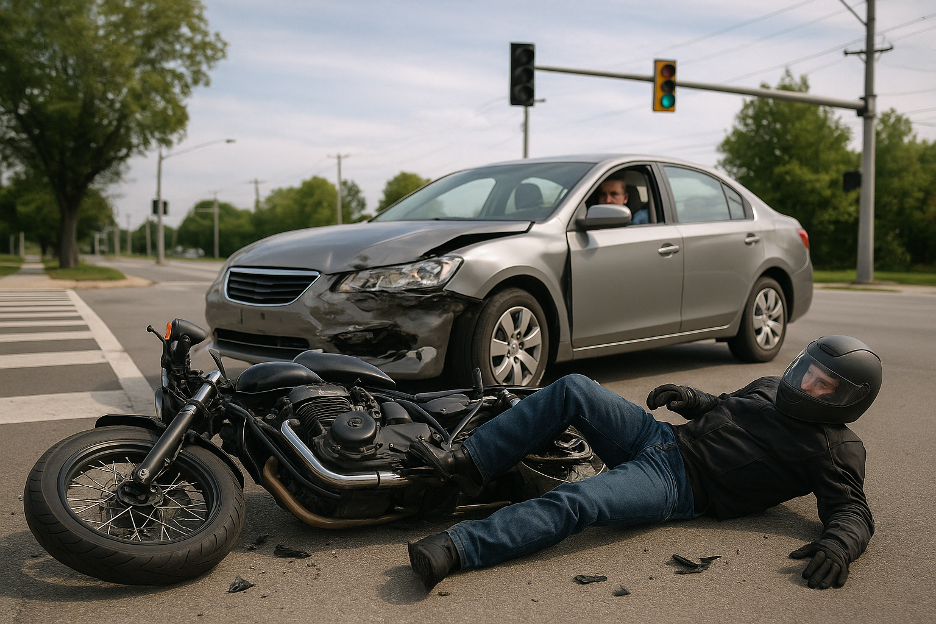
Motorcycle accident cases require more than routine legal help—they demand focused, experienced representation from attorneys who understand the unique risks riders face and the specific laws that apply to them. At Miller Tourtlotte Law, PLLC, we know the injuries in motorcycle accident cases are often catastrophic, the liability issues are complex, and the insurance companies waste no time trying to blame the motorcyclist—no matter what the facts show. If you or someone you love has been seriously hurt in a motorcycle collision in Yellowstone County, you’re likely facing lost income, long-term medical care, and uncertainty about who will be held responsible.
Miller Tourtlotte Law, PLLC brings the experience necessary to pursue full compensation in even the most difficult motorcycle accident cases. In the sections below, we explain how Montana law applies to motorcycle accident claims, the types of compensation available to injured riders and their families, and how an experienced Yellowstone County motorcycle accident lawyer can fight on your behalf to hold the right parties accountable and pursue justice.
Common Motorcycle Accidents That Can Lead to Injury or Death
Left-Turn Crashes — These accidents happen when another vehicle turns left at an intersection or into a driveway, cutting across your lane. Drivers often misjudge your speed or don’t see you at all. Left-turn crashes are among the most dangerous types of motorcycle accidents and often result in serious injuries or fatalities. Under Montana law, drivers making a left turn must yield the right-of-way to oncoming traffic (MCA § 61-8-336), including motorcycles.
Rear-End Collisions — Getting hit from behind while you’re stopped at a red light or slowing down in traffic can throw you from your bike. Because motorcycles are lighter and stop more quickly than cars, drivers who follow too closely or are distracted can cause severe damage even at low speeds. Montana law requires a driver to maintain a safe following distance (MCA § 61-8-329).
Head-On Impacts — These violent collisions often occur on two-lane roads, especially when a car crosses the centerline. The combined force of both vehicles moving toward each other can be deadly. Passing errors, drunk driving, or simple distraction are often to blame. If the other driver was on the wrong side of the road, they’re likely in violation of Montana’s lane usage law (MCA § 61-8-321).
Lane Change Accidents — Cars sometimes merge into your lane without checking their blind spot. These crashes usually happen on highways or in heavy traffic, and the results can be catastrophic. Even with loud pipes or bright gear, drivers often fail to register motorcycles. Montana law makes it illegal to change lanes without making sure it’s safe (MCA § 61-8-328).
Road Hazards — Loose gravel, potholes, wet pavement, and roadkill are more dangerous for motorcycles than other vehicles. You have far less margin for error. Poorly maintained roads may be the fault of a local or state agency, but determining liability requires careful investigation.
Speed-Related Wrecks — High speed makes it harder to avoid sudden hazards, especially on curves or rural roads. While some riders lose control on their own, others are forced into evasive actions because of another driver’s recklessness. Montana law requires drivers to drive at a speed that’s reasonable and prudent for conditions (MCA § 61-8-303).
Group Riding Collisions —One rider’s sudden stop or swerve can cause a pile-up. Inexperienced riders or poor communication often play a role. While not illegal, group riding requires clear signals and spacing to reduce the chance of chain-reaction crashes.
Serious Injuries You Can Get From a Motorcycle Accident
Road Rash — Sliding across the pavement during a crash can rip through your clothes and skin, causing painful scrapes, deep wounds, or even permanent scarring. In some cases, road rash leads to infections or the need for skin grafts.
Broken Bones — It’s common to break arms, legs, ribs, or wrists when you get thrown from your bike or hit by another vehicle. These injuries can take months to heal and sometimes require surgery.
Spinal Cord Injuries — Damage to your spine may cause long-term pain, nerve damage, or paralysis. Recovery is often slow and expensive, and some injuries lead to permanent disability.
Traumatic Brain Injuries (TBIs) — Even if you’re wearing a helmet, your head can still suffer a serious blow during a wreck. TBIs range from concussions to life-changing brain damage. Montana law requires motorcycle riders under 18 to wear helmets (MCA § 61-9-417), but injuries can still happen no matter your age.
Internal Injuries — These are hard to detect right after a crash. Damage to organs, internal bleeding, or punctured lungs might not show symptoms until it’s too late.
Amputations — In severe cases, you could lose a finger, toe, or even a limb. This can happen at the crash scene or later if doctors can’t save the damaged part. It’s a life-altering injury that comes with long-term costs and emotional impact.
Where Motorcycle Crashes Happen Most in Yellowstone County
Interstate 90 (I-90) — This major east-west highway runs straight through Yellowstone County and is one of the busiest routes for both local and commercial traffic. Crashes often happen near Billings, especially at high-traffic exits like Zoo Drive, King Avenue West, and Lockwood. Merging, lane changes, and high speeds create serious hazards for motorcyclists, particularly when drivers don’t check blind spots or follow too closely.
U.S. Highway 87 — Stretching from the edge of Billings through Shepherd and beyond, this highway mixes rural and commercial traffic. Riders on I-87 face a higher risk from sharp curves, limited shoulders, and sudden turns by slower-moving vehicles. It’s also a common route for trucks and farm equipment, increasing the odds of rear-end or overtaking collisions.
Montana Highway 3 — Leading northwest from Billings toward the airport and beyond, MT-3 runs through hilly terrain with sharp turns and changing elevations. Visibility and speed can both be problems on this route, especially near curve-heavy sections.
Montana Highway 302 (Rimrock Road) — Though it serves both city and outlying areas, much of MT-302 is surrounded by open space and winding terrain. Motorcyclists frequently use this route for leisure rides, but loose gravel and shoulder erosion present steady risks.
Montana Highway 416 (Blue Creek Road) — While lesser-known, this state-designated route serves riders heading toward the southern outskirts of the county. It’s scenic, but narrow and uneven in many areas, with minimal space to correct course if a car crosses the center line.
Major Cities in Yellowstone County — Most motorcycle crashes in the county happen near or in Billings, the largest city, because of the traffic volume and highway access. Other high-traffic areas include Laurel and Lockwood, which sit along I-90 and serve as pass-through points for both local and long-haul drivers.
Who Can Be Held Liable in a Motorcycle Crash Under Montana Law
Negligent Drivers — If someone hit you because they were texting, speeding, driving under the influence, or failed to yield, they can be held legally responsible for your injuries. Montana law requires drivers to operate their vehicles with care and regard for others (MCA § 61-8-302). Violating traffic laws can serve as strong evidence of negligence in a civil lawsuit — a concept known as negligence per se. Additionally, under Montana’s general negligence statute (MCA § 27-1-701), any person who causes harm through careless or unlawful behavior may be liable for the resulting damages. This means even if a specific law wasn’t violated, a driver can still be held accountable if their actions failed to meet the standard of reasonable care.
Commercial Vehicle Companies — When you’re hit by a delivery truck or big rig, the company behind the driver may also be liable under MCA § 27-1-701. Montana recognizes employer responsibility for on-the-job actions under the legal doctrine of respondeat superior, and negligence can also apply to poor vehicle maintenance or bad hiring decisions.
Government Agencies — If the road was poorly maintained, had missing signs, or was unsafe due to bad design, the city of Billings, Yellowstone County, or the Montana Department of Transportation could be partly at fault. Claims against public entities must follow specific procedures under the Montana Tort Claims Act (MCA § 2-9-301). These claims have tighter deadlines, so you need to act quickly.
Bars and Restaurants That Over-Serve Alcohol — If a drunk driver caused your crash, and a bar or restaurant served that person while they were visibly intoxicated, you may have a claim under Montana’s dram shop law (MCA § 27-1-710). This allows you to hold that business financially responsible.
Motorcycle and Parts Manufacturers — When a mechanical failure like brake failure or tire blowout leads to a crash, and it’s caused by a design or manufacturing defect, the company that made or sold the part can be held liable under MCA § 27-1-719, even if there was no intent to cause harm.
Role of a Motorcycle Accident Attorney in Yellowstone County
When it comes to motorcycle crashes, insurance companies often treat bikers differently. They may blame you just for riding a motorcycle or suggest you were reckless, even when the facts say otherwise. That bias can cost you. At Miller Tourtlotte Law, PLLC, our motorcycle crash lawyers push back hard. We gather crash reports, witness statements, video footage, and work with reconstruction experts to build a case that proves exactly what happened. We don’t let insurers twist the story.
Our Billings motorcycle accident lawyers also handle every part of your insurance claim and legal process, including dealing with adjusters who try to lowball you. Whether it’s negotiating or filing a lawsuit, we fight to get full compensation. In personal injury claims, that includes medical bills, lost wages, pain and suffering, and the cost of future care. In wrongful death cases, we help families recover for funeral expenses, loss of companionship, and the financial support the loved one would have provided (MCA § 27-1-513). These aren’t just numbers—they represent your future. And because motorcycle injuries are often more severe than in car accidents, the financial stakes are higher. Our firm knows exactly how to win these cases in Yellowstone County and across Montana.
Frequently Asked Questions About Billings Motorcycle Accidents
Do I still have a motorcycle accident case if I wasn’t wearing a helmet?
Yes, but not wearing a helmet may reduce how much you can recover—especially for head injuries—under Montana’s comparative fault law (MCA § 27-1-702).
What if the police report blames me for the motorcycle crash?
You can still fight back. Police reports aren’t always accurate, and your lawyer can use other evidence—like video and witnesses—to prove who really caused the motorcycle accident.
Should I talk to the other driver’s insurance about my motorcycle accident?
No. The insurance company is not on your side. Anything you say can be used against you. Your lawyer should handle all communication to protect your motorcycle accident claim.
How long do I have to file a motorcycle accident lawsuit in Montana?
You have three years from the date of the crash under Montana law (MCA § 27-2-204). If you miss the deadline, you lose your right to recover damages.
Can I sue if a drunk driver caused my motorcycle accident?
Yes, and you may also sue the bar that served them if they were visibly intoxicated under Montana’s dram shop law (MCA § 27-1-710).
Do most motorcycle accident claims go to court?
Not always. Most settle without a trial. But if the insurance company lowballs you, your lawyer can file a lawsuit and fight for fair compensation in court.
What damages can I claim after a motorcycle accident?
You can recover money for medical bills, lost income, pain, future care, and property damage. If someone died, wrongful death damages may also apply under Montana law.
What if I was riding as a passenger in a motorcycle accident?
You still have legal rights. You may be able to sue the other driver, the motorcycle operator, or both—depending on who was responsible for the crash.
How do I prove who caused my motorcycle accident?
Crash reports, photos, video, witness statements, and expert accident reconstruction can all help show who was at fault for your motorcycle crash and why they’re legally responsible.
Can I afford a Billings motorcycle accident attorney?
Yes. We don’t charge upfront. You pay nothing unless we win your motorcycle accident case, either through a settlement or a court verdict. That’s called a contingency fee.
Yellowstone County Montana Motorcycle Accident Attorney
Motorcycle accident cases are high-stakes, and insurance companies know it. So do we. At Miller Tourtlotte Law, PLLC, our Billings auto accident attorneys bring decades of combined experience standing up to insurers and holding negligent drivers accountable—especially when motorcyclists are the ones paying the price. Founding attorney Matt Tourtlotte has spent over 20 years litigating complex insurance disputes, while A.J. Miller’s background representing insurance companies gives our firm a tactical advantage when fighting for injured riders. We know how these companies think, and we know how to hold them to the law. If you’ve been seriously hurt or lost someone in a motorcycle crash, we’re here to take on your legal burden while you focus on recovery. Contact Miller Tourtlotte Law, PLLC by calling (406) 888-2222 or contacting us online for a free consultation.